.svg)
.svg)
.svg)
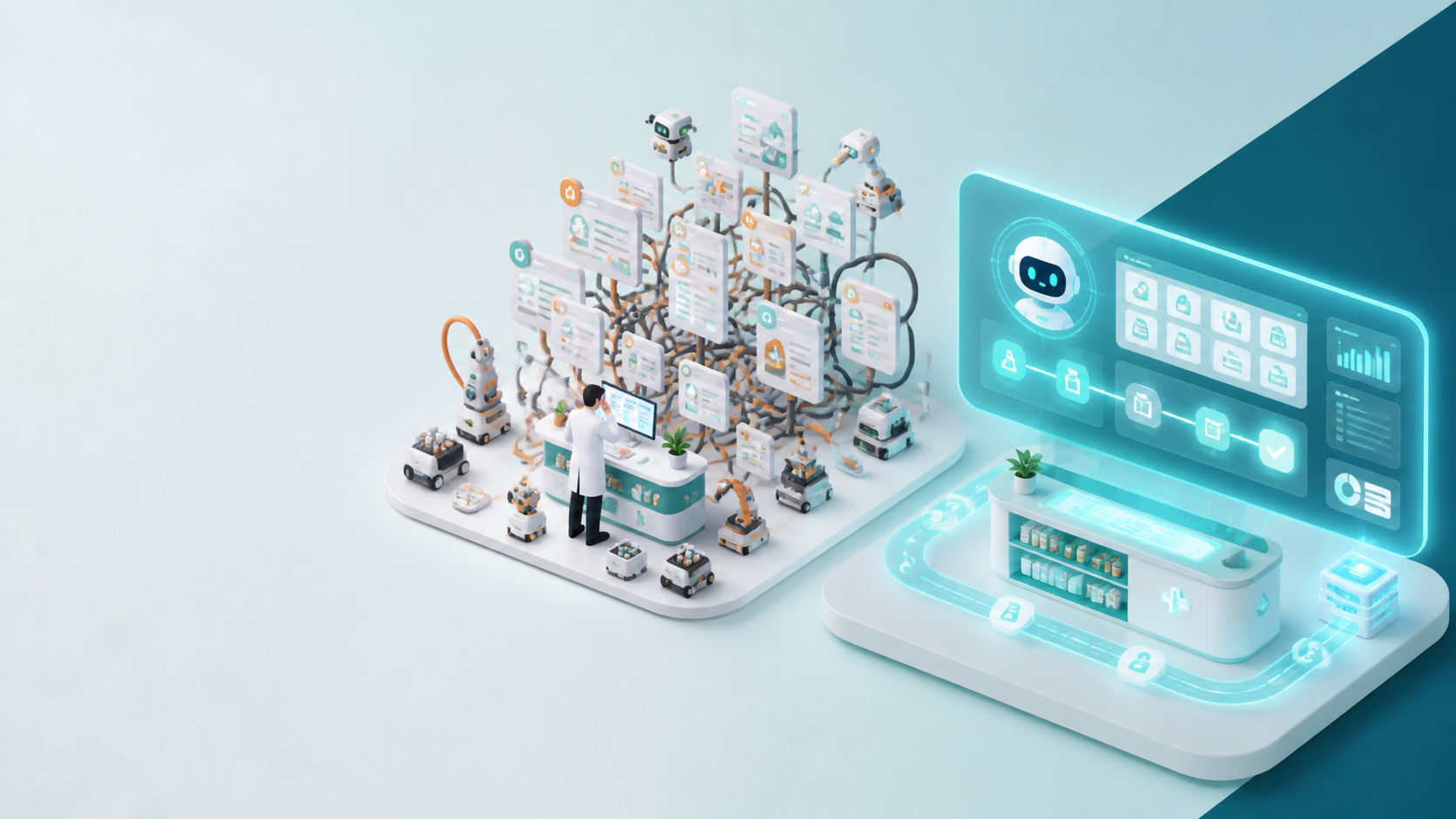
In calls with independent pharmacy owners this summer, the same complaint surfaced again and again, from operators who had never spoken to one another: every time a new workflow needed automating, the answer was another pharmacy automation tool.
The Pharmacy Automation Pattern Nobody Planned For
None of these pharmacies set out to run four automation vendors. Each one showed up to solve a single problem.
A specialty pharmacy that had built its own tooling for benefits checks described the frustration plainly. Every time a new kind of task came up, the answer was a whole separate, single-purpose tool rather than an extension of what they already had. A multi-location group already running an automation tool found its output rigid and mechanical, with no way to change the logic without developer involvement. More than one specialty operator said their current tool handled its narrow lane fine. Anything unusual, an oddly formatted referral or an unfamiliar document, got kicked out and rerouted to a staff member by hand.
Different pharmacies, different tools, same shape of problem: the automation only covered exactly what it was built for, and nothing else.
Why Single-Purpose Pharmacy Automation Breaks Down
The cause is how these tools are built. Most pharmacy automation on the market today is a fixed script written for one task on one screen. That works right up until the pharmacy's workflow changes, a payer updates a portal, or a new task type shows up that the script wasn't written for. At that point, someone, usually a developer, has to rewrite the logic. Until that happens, the tool simply can't do the new thing, and the pharmacy either does it by hand or goes looking for another vendor.
The real cost of single-purpose tools shows up eighteen months in. By then the pharmacy is running three or four narrow tools that don't talk to each other and can't be extended without help. The license fees are the smaller part of that bill.
There is little room to carry it. Independent pharmacy gross margins fell to 18.2% in 2024, the lowest in the NCPA Digest's tracking history (NCPA Digest 2025). Overlapping software bills are one of the few costs an owner can actually take off the table.
We covered the deeper architecture questions behind this in Bots Are Not AI Agents and The Pharmacy AI Architecture Question.
What One AI Technician Replaces
PAT (Pharmacy AI Technician) is a governed AI Technician that drives a pharmacy management system through the screen over an encrypted tunnel, with no API required and the pharmacist in the loop on every clinical decision. Because it works across the pharmacy management system and the applications around it, rather than inside one corner of it, a new workflow doesn't mean a new tool. Task logic is written in plain English and added to what's already running, with nothing new installed at the pharmacy and no developer ticket.
That only works if the system is honest about its limits. When PAT hits something its current logic doesn't cover, whether that's an unfamiliar format or a case that needs a pharmacist's judgment, it skips that item, flags it with a reason, and keeps the rest of the queue moving. The logic then gets extended to cover it. Nothing gets guessed at, and nothing silently fails.
Pricing follows the same logic. PAT is priced per completed task, so adding a workflow adds work, not another license. The result is one flexible layer that grows with the pharmacy's workflows instead of a shelf of single-purpose tools that each stop at their own edge.
Before You Add Another Tool
If your pharmacy is evaluating a new single-purpose tool for a new workflow, three questions are worth asking first:
Does this tool only solve this one problem, or can new tasks be added without a new install or a developer?
What happens to the tools you already have once you add a fourth or fifth workflow? Do they start overlapping or conflicting?
When the process changes six months from now, who has to get involved: your team, or a developer on the vendor's side?
The pharmacies getting the most out of automation right now run the fewest tools that still cover the most ground.
See how one AI Technician compares to a stack of single-purpose tools in the Pharmacy Automation Comparison Guide, or see how PAT works in a live pharmacy.
Frequently Asked Questions
Can one AI Technician replace several pharmacy automation tools?
In many cases, yes. Because PAT drives the pharmacy management system and the applications around it through the screen, a new workflow is added as plain-English task logic rather than as new software. Whether a specific tool can be retired depends on what it does today, which is why pilots start with one or two workflows.
Does PAT need an API or a new install at the pharmacy?
No. PAT works with the existing pharmacy management system over an encrypted tunnel. There is no API required and nothing new installed at the pharmacy.
What happens when PAT hits a task it can't complete?
It skips that item, continues the rest of the queue, and sends the reason for review, with no patient information in the notification. The pharmacist stays in the loop on every clinical decision, and the task logic is then extended to cover the case.
How is PAT priced?
Per completed task, with a monthly minimum that applies per deployment rather than per location, and a pilot that runs the first two weeks free. Current figures are on the pricing page.
.svg)