.svg)
.svg)
.svg)
The pharmacy AI conversation has one dominant question: what can it automate?
It is the wrong first question.
Before you ask what an AI agent can do, you need to ask something more fundamental. Where does it live? What does it have access to while it is doing its job? And what happens when something goes wrong?
Most pharmacy owners evaluating AI have never been asked these questions by a vendor. That silence is worth paying attention to.
There Are Two Fundamentally Different Architectures, and the Industry Is Not Telling You
Not all pharmacy AI agents are built the same. The difference that matters most is not the AI model, the workflow list, or the demo. It is where the agent runs.
Two architectural camps exist. In the first, the agent runs inside your pharmacy network: installed on local workstations or servers, with direct access to your PMS, your local files, and your network resources. In the second, the agent runs entirely outside your walls, in an isolated and governed cloud environment, reaching your PMS through an encrypted tunnel.
Most vendors in the market today are built on the first model. Few talk about it openly.
"Easier to deploy" and "already inside your systems" sounds like a feature. It may be a liability.
What "Inside Your Network" Actually Means
Imagine the agent as a contained, task-focused tool. That is a reasonable first impression from a demo. The architecture often tells a different story.
An on-premise agent runs inside your LAN. It has access to your PMS, and in many cases to the workstations your staff uses, your local file system, and other networked resources. That access exists because the vendor needed it to make the product work. It is rarely scoped to the minimum necessary. And it is rarely explained in the sales conversation.
The uncomfortable question is straightforward: if your AI agent is compromised, or behaves unexpectedly, or is accessed by a third party, what does it reach? Where does the exposure stop?
On-premise agents do not come with a natural boundary. That boundary has to be built, configured, and maintained by someone. Usually that means your staff or an IT engagement the vendor did not mention in the demo.
The Problems That Follow an Agent Into Your Network
These are not hypothetical edge cases. They are structural consequences of where the agent runs.
- "It is easier to deploy," maybe. It is harder to contain. Expanding your network attack surface is easy to overlook when the demo goes smoothly. A compromised agent inside your LAN is not an isolated incident. It is a threat actor inside your LAN, with access to whatever your agent can reach.
- "It is HIPAA compliant," but compliant logging is not the same as governed access. An agent with broad network access can reach PHI it was never intended to touch. Limiting that access requires deliberate, ongoing configuration. Ask any vendor to show you exactly what their agent can and cannot access at runtime, not in a slide deck, but in a live environment. The answers are often incomplete.
- "It runs on your hardware," but who pays when you need more? On-premise agents scale by adding local workstations. More dispensing volume means more hardware at your expense, managed on your side of the wall. The vendor's software scales. Your infrastructure cost scales with it.
- "Your staff uses the same workstations," and so does the agent. In most on-premise models, the agent and your pharmacists compete for the same hardware. During peak dispensing volume, that contention is real. The agent wins, or the pharmacist does. Neither outcome is acceptable.
- The audit trail question. When an AI agent operates inside your infrastructure, the completeness of your audit record depends entirely on what that agent logs about itself. In a HIPAA audit or a liability dispute, "the vendor's software tracked it" is a meaningfully weaker position than a governed, externally maintained session log with video replay and action-level attribution tied to a session ID. These are not equivalent. The HHS guidance on audit controls makes clear that covered entities are responsible for demonstrating what happened inside their systems, not just that a log exists.
Rethinking What "Secure" Means for Pharmacy AI
The industry has defaulted to "HIPAA compliant" as the primary security signal. That standard was written for data storage and transmission. It was not written for autonomous agents making decisions inside clinical systems at scale.
The more useful question is not "is it compliant?" It is: where is the agent relative to my data, and who controls the boundary between them?
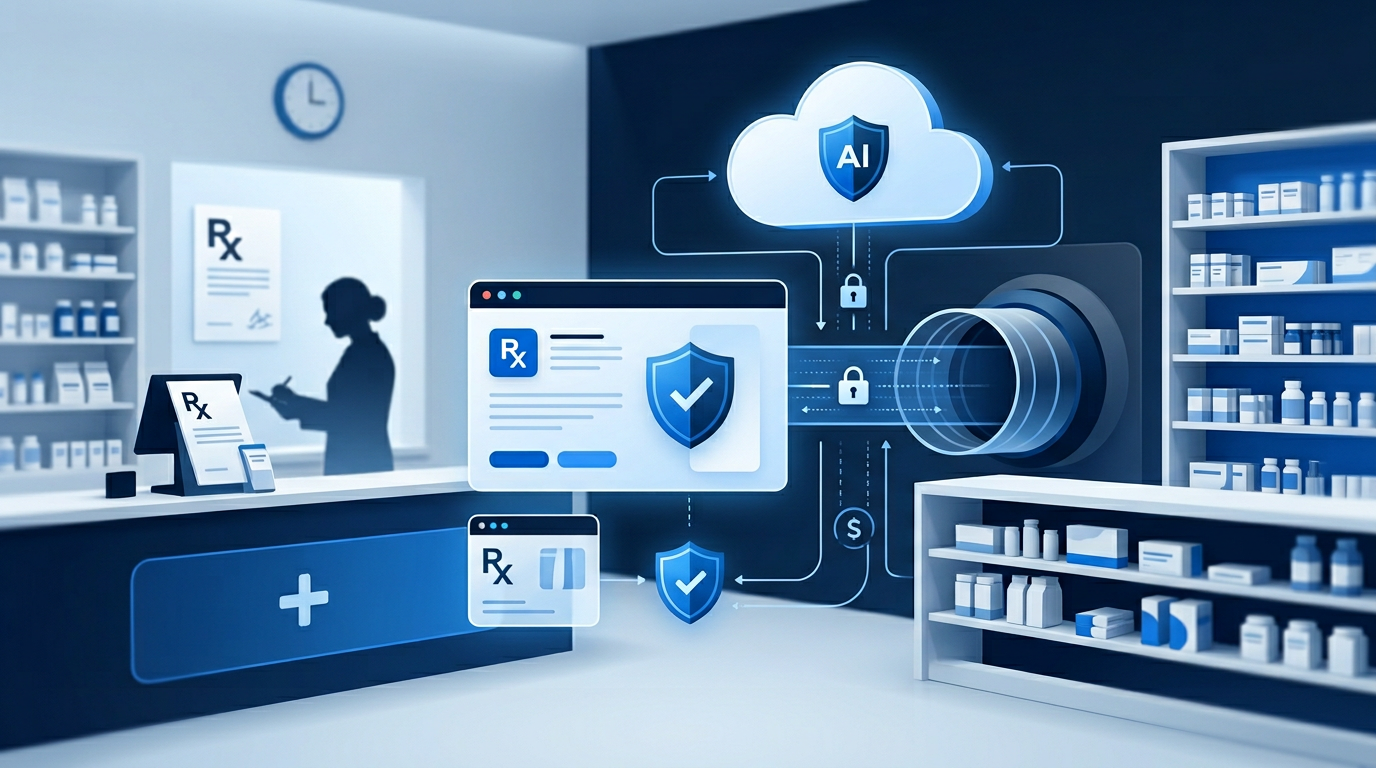
A cloud-isolated model starts from a different architectural premise. The agent should never be inside your network in the first place. It connects to your PMS through an encrypted, outbound-only tunnel. It operates through the screen, exactly as a pharmacy technician would. Your network boundary is left untouched.
Every action passes through a governance layer before it reaches any application. The agent can only reach what it is authorized to reach, and it approaches that boundary from the outside.
That is not a compliance feature. It is an architectural choice that makes compliance easier to demonstrate, easier to audit, and easier to defend when someone asks you to prove it.
This architecture also matters given where pharmacy staffing stands today. Pharmacy Times research on the technician workforce has consistently flagged technician shortages and burnout as a structural problem, not a temporary one. Any automation layer added to that environment needs to relieve pressure, not introduce new operational or compliance risk.
What the Alternative Looks Like
PAT (Pharmacy AI Technician) runs entirely in the Sonet cloud. It connects to the pharmacy's PMS through an encrypted tunnel. The PMS stays exactly where it is: on-premise, in a vendor cloud, or wherever it lives today. Nothing moves.
The agent never enters your network. The connection is outbound-only, established at your network boundary. No new inbound ports. No agent software running on staff hardware. Your existing security posture is unchanged.
Every action PAT takes passes through a governance layer before it reaches any application. Every session is recorded. Every action is logged and attributed to a session ID. That audit trail is maintained externally, not by the agent reporting on itself.
Below is a direct comparison of what these two architectural approaches mean for your pharmacy in practice.
| Agent Inside Your Network | PAT (Cloud-Isolated) | |
|---|---|---|
| Agent location | Runs on your hardware, inside your LAN | Sonet cloud, never enters your network |
| PHI exposure | Broad local network access | Governed session only, DLP enforced |
| Network attack surface | Expanded by agent presence | Your existing posture unchanged |
| Workstation contention | Agents compete with staff for hardware | Separate virtual workstations, no contention |
| Scaling cost | Hardware investment at your expense | Cloud-elastic, no capital cost |
| Audit trail | Depends on vendor's own logging | Full session recording, externally maintained |
| Setup burden | IT engagement required | Encrypted tunnel install, typically same day |
The Three Questions to Ask Before You Sign Anything
If you are evaluating pharmacy AI, these questions will tell you more than any demo.
1. Where does your agent run? Is it inside my network or outside it? If the answer involves installing software inside your LAN, ask what it has access to and who limits that access.
2. What is the boundary between your agent and my systems? Who defines it? Who maintains it? If the vendor deploys into your infrastructure, the honest answer is: you do, with their help. That is an ongoing operational responsibility your team is absorbing.
3. What does my audit trail look like, and who owns it? Can you export it independently of the vendor's platform? If a liability question arises, can you produce a complete record that does not depend on the vendor's cooperation? If the answer is unclear, that is your answer.
Vendors who cannot answer these questions clearly are not declining because the questions are unfair. The architecture makes the answers uncomfortable.
The Right First Question
The pharmacy owners who come out ahead on AI are not necessarily the ones who deploy first. They are the ones who understand what they are deploying before they sign.
The demo will show you what the agent can do. The architecture determines what the agent can reach, what happens when something goes wrong, and whether you can prove what happened afterward.
Where your AI agent lives is not a technical footnote. It is the decision that determines your risk posture, your compliance story, and your leverage if things go sideways.
Ask the question before the contract is in front of you.
For more on why pharmacy management system vendors are structurally unable to deliver this kind of architecture, see Why Your PMS Vendor Can't Deliver AI.
Want to see exactly how PAT connects to your PMS without entering your network?
We will walk you through the architecture, the governance controls, and the audit trail in a 30-minute session. No slides. No demos of features you did not ask for. Just the answers to the questions above, with your specific PMS in the conversation.

.svg)