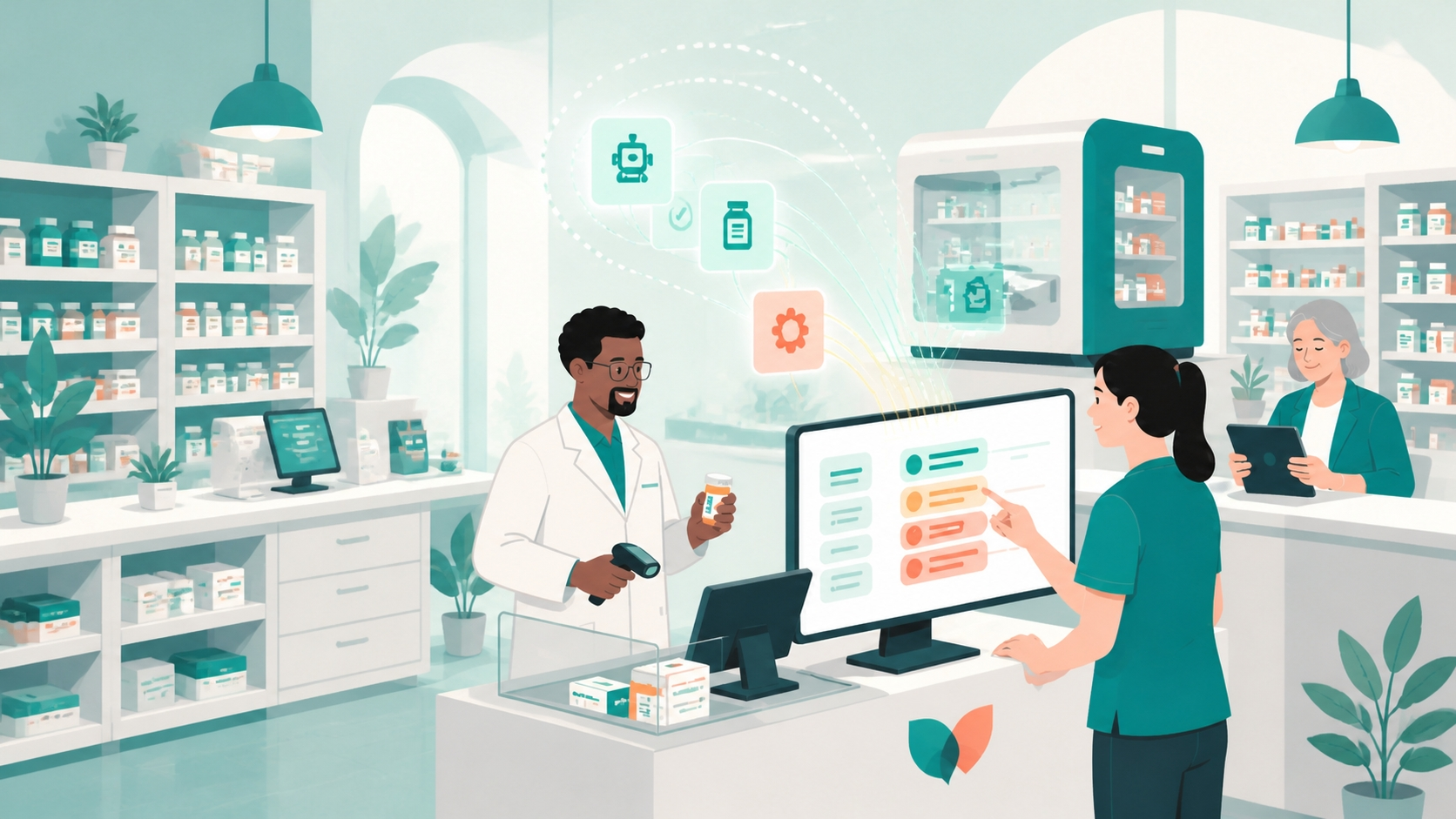

Ask independent pharmacy owners what they want to know before piloting pharmacy automation and, once the demo is over, the question gets practical: how much training does my team need, and who has to sit through it? The worry underneath is time. A pharmacy that is already short a technician does not have a spare afternoon for a software class, and most owners have watched a piece of pharmacy technology eat a week of a senior technician's attention before it earned anything back. It is a fair question, and it deserves a role-by-role answer rather than a reassurance.
Here is what owners should expect, and how PAT (Pharmacy AI Technician) is built to keep the learning short.
The Pharmacy Automation Training Question Comes Down to Three People
Three people in a pharmacy are affected when automation starts working a queue: the pharmacist who verifies, the technician who used to work that queue, and the owner who has to know whether it is going well. Each of them learns something different, and how much they learn depends on one design question that is worth asking of any pharmacy automation: does it ask your staff to work on a new screen, or does it work on the screens your staff already know?
Tools that bring their own interface bring their own training. Every person who touches the workflow has to learn a new place to look, a new set of statuses, and a new habit for checking it against the pharmacy management system they actually run on. That is where the week of a senior technician's attention goes.
PAT (Pharmacy AI Technician) is a governed AI Technician that drives the pharmacy management system your team already uses through the screen, over an encrypted tunnel, with no API required and nothing new installed at the pharmacy. There is no second application to open and no new set of statuses to learn. Its work appears where your team already looks, in its own queue inside the system they know. Most of what the team learns is where to look, and that is a short lesson.
What Each Role Learns Before Pharmacy Automation Goes Live
The pharmacist learns where the exceptions land. The verification step does not move. PAT works ahead of pharmacist verification, never around it, so the pharmacist checks prescriptions the way they do today. What is new is small: PAT's completed work shows up in its own queue, and when PAT meets a prescription its task logic does not cover, it skips that one, keeps the rest of the queue moving, and sends the reason for review. The notification carries no patient information, and the pharmacist opens the record in the pharmacy management system to make the call. Every clinical decision stays with the pharmacist, by design, which means the pharmacist's training is mostly knowing which queue to glance at and how to read a log entry.
The technician learns which queue is PAT's, and how to read the rules. PAT works in dedicated queues set up for it inside the pharmacy management system. Staff queues are untouched, so the first thing a technician learns is the boundary: this queue is PAT's, these are ours. We described how that boundary makes a pilot easy to judge in Run It Alongside First. The second thing is the task logic itself. It is written in plain English, in the words a technician would use to explain the job, and it is readable and editable by pharmacy staff. Reading that page is the training. A technician who can read it can also challenge it and change it, which we wrote about in Who Owns the Rules.
The owner learns the morning review. One habit: read what ran, what was finished, what was skipped and why. Every action PAT takes is logged with the logic it applied, so the review is a matter of reading rather than asking around. We laid out what that log looks like in What Did Your Pharmacy Automation Do Last Night?. For an owner, that is the whole curriculum.
Why Most of the Training Runs the Other Way
The larger piece of learning in a PAT rollout is PAT learning your pharmacy. The first task starts with how your staff work it today. Sonet's team watches the task and writes it down as plain-English instructions, the kind you would give a new technician on their first day, and your team reads and edits that baseline before anything runs. When PAT later meets a case the logic does not cover, the pharmacist decides, and the logic expands to cover it. Changes to task logic are included, at no additional charge.
That order matters for the training question. Your staff are the teachers. The expertise the automation needs is already in the building, in the head of whoever works the refill queue best, and the setup conversation is about getting it onto a page. We have written before that the AI you choose has to earn your team's trust. Trust comes faster when the team recognizes its own rules in the instructions, because then there is nothing foreign to learn.
A Practical Way to Size the Training Before You Pilot
Three steps, in order.
List everyone who touches the queue you want to automate. Usually it is one pharmacist, one or two technicians, and you. If the list is longer, the queue is probably bigger than a first pilot should be.
Write one sentence per person. What is the single thing this person needs to know on day one? For the pharmacist, where exceptions land. For the technician, which queue is PAT's and where the rules are. For you, where the log is. If any of those sentences gets long, ask the vendor why.
Put the review habit on the calendar. A few minutes each morning in the first week, with the log open and your most skeptical technician in the room. That is the training that sticks, and it costs far less than a class.
See how a pilot starts, and what the first two weeks look like for the team, at pharmacy.sonet.io.
Frequently Asked Questions
How much training do pharmacy staff need to work with PAT?
Very little, because PAT works on the pharmacy management system your team already uses rather than on a new screen. The pharmacist learns where exceptions land, the technician learns which queue is PAT's and how to read the plain-English task logic, and the owner learns the morning review of the log.
Do technicians have to learn a new system?
No. PAT drives your existing pharmacy management system through the screen, with nothing new installed at the pharmacy and no second application to open. Its work appears in its own dedicated queue inside the system your technicians already know.
What does the pharmacist have to learn?
The verification step stays exactly where it is. The pharmacist learns which queue holds PAT's completed work and how to read the reason when PAT skips a prescription. The notification carries no patient information, and every clinical decision stays with the pharmacist.
Who teaches PAT how our pharmacy works?
Your team does. The first task starts with how your staff work it today, written down in plain English and reviewed and edited by your team before anything runs. Pharmacy staff can read and change the task logic afterwards, and changes are included at no additional charge.